
Royal Bumi Care
Royal Bumi Care Program is one of the Margaraja programs combined efforts of both The People’s Raja – Royal Bumi and the Marga Group towards proper spatial planning within and around forest boundaries.
With Royal Bumi Care program, will attract visitors from around the world to acknowledge about the care of our well-conserved forest areas, located at Kalimantan, Indonesia, where a large area of forest that still harbors numerous unknown and endemic species that have not yet been described.

The People’s Raja – Royal Bumi and the Marga Group, such cooperatives have several legal precedents to increase higher levels of awareness for the protective role of local forests and local communities with a tenure right to sustainably manage and use forest resources. As cases around the world have indicated, successful efforts to prevent deforestation and to manage forests sustainably come from grassroots communities living around and within forest areas. There are successful experiences worldwide that prove how community and private sector involvement can be a viable path for sustainable forest care and management.
With the Royal Bumi Care program, we have a system that promotes forest protection and forest management. It is a public-community-based forest management focusing on various initiatives and strategies to create a sense of ownership and responsibility towards our earth and nature. Their actions contribute to conservation efforts and sustainable development. Educational campaigns, workshops, and training programs will be held consistently to increase people’s awareness of sustainable practices, reforestation, and wildlife conservation.
Remark:-
The word “Bumi” is derived from the Sanskrit word bhūmiḥ (भूमिः) meaning “earth” or “land”, and it also holds the same meaning in Thai, Malay, and Indonesian.

The Rain Forests of Kalimantan
Kalimantan, which has large areas of forest, encompasses a variety of forest types comprising mangrove forest, coastal forest, swamp forest, evergreen tropical rainforest, forest over limestone and heath forest, and stretching from sea level up to 2556 m altitude. The mixed dipterocarp forests are situated mostly in lowland areas, below 600m altitude.
Did you Know?
Indonesia is home to 10% to 15% of all known plants, mammals and birds on the planet.
Kalimantan, which has a large area of forest, is believed to be one of the islands that still harbors numerous unknown and endemic species that have not yet been described. This is a reasonable assumption because, in the area of flora, most biologists (especially botanists) agree that the Indonesian provinces of the Kalimantan area are still under-collected. Relatively few botanical explorations have been made in the past. In the period 1989–1999, collections by the staff of the Wanariset Herbarium added more than 11000 items to the collection of Kalimantan (Sidiyasa et al., 1999). These collections comprise mainly trees from the East Kalimantan area.
Lowland Forest
The area where lowland forest occurs refers usually to the area below 700 m above sea level and does not include specific habitats like kerangas forest, swamp forest, coastal forest, and mangrove forest. Most of the Kalimantan forests are in this category, where the Dipterocarp species may be dominant. In many cases, the dominance of the Dipterocarpaceae in the area is related to their trunk or bole sizes, which are usually very large. It is different from the family of Euphorbiaceae, which is also very often dominant, but the dominance is related to the higher number of genera and species found.

Nine genera of Dipterocarpaceae:
Shorea
Shorea is a genus of about 196 species of mainly rainforest trees in the family Dipterocarpaceae.

Nine genera of Dipterocarpaceae:
Anisoptera
Its bark is flaky and has vertical cracks. Its wood is pale and yellowish, it makes light hardwood timber. Eight out of the ten species are currently listed on the IUCN Red List.

Nine genera of Dipterocarpaceae: Parashorea
Parashorea trees have hard wood, can reach heights exceeding 70 metres, and have limbs reaching outward over ten metres. White seraya is a common name for several Parashoreaspecies used in the timber trade.

Nine genera of Dipterocarpaceae: Dipterocarpus
The genus is of considerable importance as timber trees and for producing resinous oil. The oil is sold under the trade names gurjun oil, kanyin oil, wood oil, and Keruing oil. The species also acknowledged for use in traditional herbal medicine.

Nine genera of Dipterocarpaceae:
Cotylelobium
The name Cotylelobium is derived from Greek (kotyle = a small cup and lobos = a pod) and describes the receptacle.

Nine genera of Dipterocarpaceae:
Dryobalanops
The genus has seven species, confined to the tropical forests of West Malesia. It is among the most abundant species of emergent trees in these forests, growing up to 80 m tall.

Nine genera of Dipterocarpaceae:
Hopea
Trees in this genus are small or medium, but they can grow occasionally large. They have low branches and sometimes thick buttress roots. Their bark is chocolate brown and smooth at first, but later crack and mottle with grey spots.

Nine genera of Dipterocarpaceae:
Vatica
The genera of this group have valvate sepals in fruit, solitary vessels, scattered resin canals,

Nine genera of Dipterocarpaceae:
Upuna
It is a monotypic species that is endemic to Borneo. It grows to about 45 m tall and 1.5 m in diameter and has dark brown and finely flaky bark; and vegetative branch with thinly coriaceous and somewhat bullate leaves.

Iron Wood:
Eusideroxylon Zwageri
Produces hard and durable timber, giving it the common name Ironwood. These trees mostly adapted to flat lands along rivers, sometimes dominant, and it is extremely slow growing.

Koompassia Excelsa
It is one of the tallest tropical tree species. the tallest measured specimen is 85.8 m or 88 m tall.

Pometia
Pinnata
Grow along the rivers and small tributarys. Easy to look as their young leaves are in dark red colours.

Dracontomelon dao
The Argus pheasant-tree, normally use as one of the ingredients in some popular Vietnamese dishes.
Durio
spp
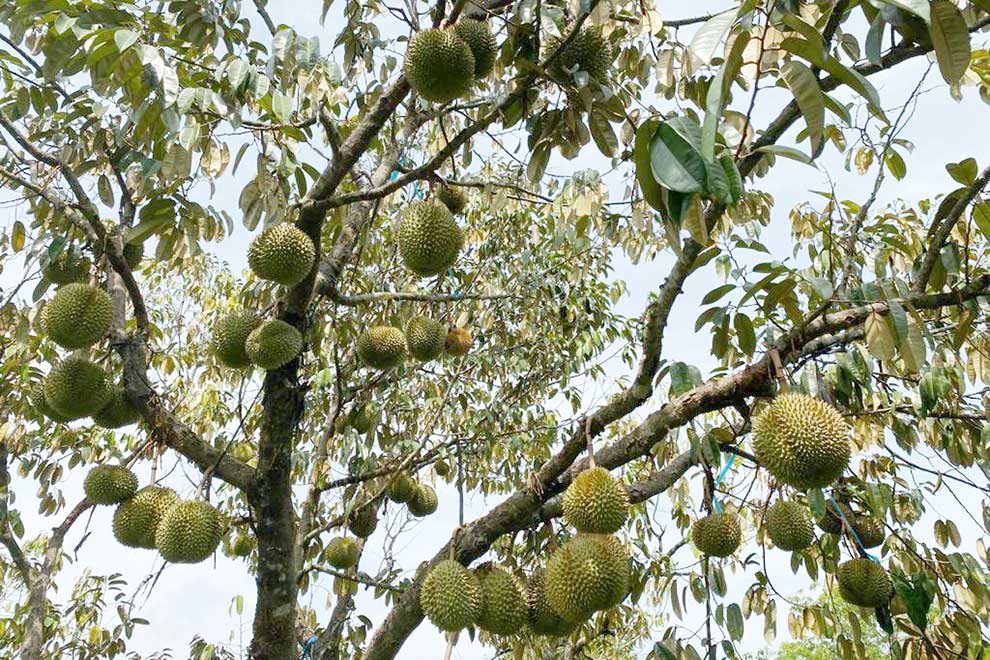
Well known because of their fruit named Durian fruit.

Artocarpus
spp
Well known because of their fruits, which are edible, named breadfruit and jackfruit which are cultivated throughout the tropics.

Dialium
spp
It is a genus of flowering plants in the family Fabaceae.

Sindora
spp
It is one of the famous tropical hardwood species found in Southeast Asia. Well-known for their timber quality

Palaquium
spp
This tree produce sap or latex, and their seeds used to make soap and candles, occasionally in cooking.
Montane Forest
This characteristic is very obvious when the habitats are rocky or are higher than 1600 m altitude. Very few Dipterocarp species occur at this level. During our botanical exploration in the Kayan Mentarang National Park (Mt. Lunjut and Mt. Mencah), four species of Dipterocarpaceae were collected. They are Hopea mengerawan, Shorea curtisii ssp. curtisii, Shorea sp. and Vatica oblongifolia.

Hopea Mengerawan
The tree is harvested from the wild for local use of its resin and good quality wood. The wood is a source of ‘merawan’ timber and is commonly harvested from the wild and traded. The tree is classified as ‘Critically Endangered’ in the IUCN Red List of Threatened Species(2010)

Shorea Curtisii ssp
Large buttressed tree. Young twig, panicle, leaf bud, stipule outside (glabrescent within) petiole, and midrib and nerves beneath densely shortly evenly caducous pale pink-brown to grey puberulent.
Heath forest
In Kalimantan and the other parts of Borneo, this forest formation is called ‘kerangas’. The forest grows on very acid soils, that usually consist of white sand. The most common tree species that occur in kerangas forests are Shorea balangeran, Cratoxylum glaucum and Eugenia spp. Some species of Lithocarpus and Buchanania arborescens also occur here.
Swamp forest
Depending on the type of the habitat of its occurrence, this forest is may be called ‘peat swamp forest’, if it occurs in a wet area with waterlogged condition, or ‘freshwater swamp forest’, if it occurs in an area where flooding is periodic, either daily, monthly or seasonally. In peat swamp forest, some tree species such as Gonystylus bancanus, Alstonia pneumatophora, Alstonia spatulata, Cobretocarpus rotundatus (Anisophylleaceae), Dactylocladus and Lophopetalum javanicum grow particularly well. In freshwater swamp forest many more species are usually adapted to the habitat conditions. Calophyllum spp., Eugenia, Vatica venulosa, Horsfieldia spp. are common here.
Join forces with our Royal Bumi to protect Mother Nature
for the preservation of green forest

Global Community for Forest Management
Community Forest Management in Nepal
The study confirmed that the Nepalese land tenure regime and local monitoring were of central importance for successful reforestation. By 2009, Nepal’s community forest management program included 1.6 million people or one-third of Nepal’s population. They managed 1 million hectares or a quarter of Nepal’s state forests. As a result, a study shows CFUGs have increased the average annual household income of forest users from USD 710 in 2003 to USD 1,512 in 2008 through forest-based products such as spices and resin, to name just a few. The generation of more income went along with the creation of community-based forestry enterprises with 90 percent of employment going to those from poor or very poor households.
Usufructuary Rights and Tree Ownership in Niger
Land regeneration and community forestry have created another success story in the Sahel region of Africa. Many had perceived the desertification of Niger’s agricultural land as irreversible after it had been hit by deforestation and severe drought during the 1970s -1980s. Today, 5-6 million additional hectares of land are covered by trees – all as a result of farmer incentives and community efforts. According to the World Bank, the “transition from state ownership of trees to de facto recognition of individual property rights” was key to this transformation.
Since 90 percent of Niger’s population lives off agriculture, the benefits of nurturing trees have helped even the poorest communities. According to some estimates, the application of FMNR and the granting of usufructuary rights in Niger led to 200 million new trees on 5 million hectares of farmland which produces 500,000 tons more grain and USD 56 more benefits per hectare per year. The improvement of soil, animal fodder, and firewood supplies has improved the life of an estimated 2.5 million people in Niger.
Community-Based Plantation Forests in Gunungkidul, Indonesia
Since the government generally owns all Indonesian forests, community forestry has only been applied on a very limited scale and only on land specifically designated by the Environment and Forestry Ministry for community forestry. The area of Gunungkidul was once a degraded and arid area from years of deforestation. It has since been reforested with tree plantations, which have been grown by cooperatives of smallholders.
According to Law 25/1992 Indonesian cooperatives are legal entities whose members cooperate for their economic betterment and this also guides the plantation cooperatives in their business decisions. Some cooperatives, such as Koperasi Wana Manunggal Lestari and Koperasi Wana Lestari Menoreh in Gunungkidul, choose sustainable plantation practices and gained sustainable forestry certification from the Indonesian Ecolabelling Institute (Lembaga Ekolabel Indonesia) for their timber products. This allows them to sell certified timber at prices that are 10-15% higher than those of uncertified producers. The collaboration of both cooperatives in Gunungkidul created 40 hectares of certified wood plantations in 2012 and the intercropping of trees helps provide short-term income. Similar to the international experiences mentioned above, the involvement of communities in Indonesia proves to be vital for sustainable forest management.
Public Private Partnership in Kinabalu Park, Malaysia
The Kinabalu Park covers an area of 754 square kilometers around Mount Kinabalu in Malaysia. In 2000, UNESCO granted it the status of a World Heritage Site because of its global importance as a ‘Centre of Plant Endemism’ with an outstanding range of naturally functioning ecosystems.
The park is being overseen and managed by the Malaysian government through the Sabah Parks organization. In 1998, it was decided to privatize the park’s hotel accommodation, restaurants, and souvenir shops to improve tourism facilities. A 30-year lease agreement was granted to a private company to reduce the burden of the state government in terms of administration, financial, and human resources. The Kinabalu Park has since been a public-private partnership.
The privatization of the tourism facilities in Kinabalu Park aimed to increase revenue generation from park visitors. Improvements in the tourism business were also to create jobs for the local population, and the increased number of park visitors was to develop more businesses in external areas adjacent to the park. However, an academic assessment several years after the privatization of the tourism facilities found that revenues generated from eco-tourism did not channel funds into conservation–related research and training programs. Instead, the money went into the development and improvement of new tourism-related facilities and activities.
The same study of the tourism facilities in Kinabalu Park also lamented that local communities did not report an increase in job opportunities. This is indeed a reason for concern be
